Minimal surfaces
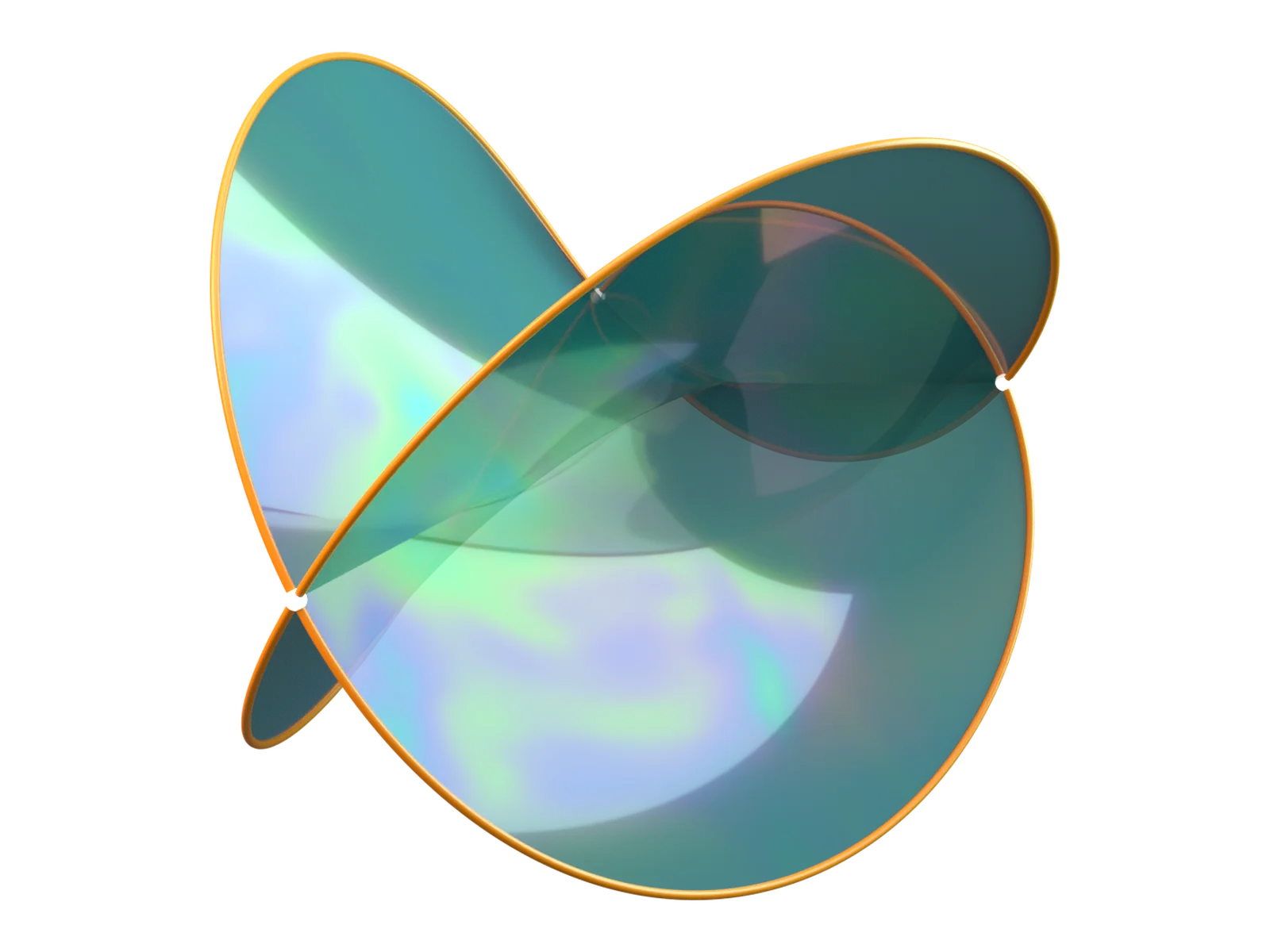
A soap film on a wire loop has the least area it can, and surfaces like that are called minimal surfaces. In a 2006 paper, Arthemy Kiselev gets an infinite family of them out of the symmetries of one equation. Below are those surfaces, how they're built, and one whose edge is a trefoil, the knot from the front page of this site.
The Legendre transform
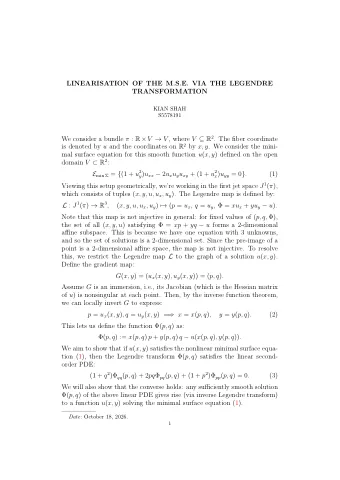
As a graph $z = u(x,y)$, a minimal surface satisfies
which is nonlinear. Setting $p = u_x$, $q = u_y$ and $\phi = xp + yq - u$ turns it into a linear equation for $\phi(p,q)$,
and each solution gives back a minimal surface through
The normal to the surface at the point coming from $(p,q)$ is $(p,\,q,\,-1)$, whatever $\phi$ is. So $(p,q)$ is really a direction, and the colours on this page show it: same colour, same direction, on every surface.
The proliferation map
Since the equation is linear, its solutions $\phi(p,q)$ are also symmetries $\varphi(u_x,u_y)$ of the minimal surface equation, and bracketing symmetries with each other gives new ones. Bracketing with the rotation $\varphi_3^{12}$ gives
where $\theta$ is the polar angle in the $(p,q)$-plane, hence the spiral. Starting from $\phi_5 = q\arctan p$, two other brackets give $\phi_6$ and $\phi_7$, and $R$ takes it from there along two chains. Click a surface to load it below.
$\Sigma_{14}$ and $\Sigma_{15}$ aren't in the paper; I computed them as the next step of each chain.
Pick one up
The slider sets the radius of the patch in the $(p,q)$-plane. Small patches are nearly flat and the folds show up as it grows. Moving over the small disc shows where each direction lands, with its tangent plane.
Switching surfaces morphs one into the other, and each frame of the morph is a minimal surface too, since $(1-s)\,\phi_a + s\,\phi_b$ solves the same linear equation. The colours stay put because the normal only depends on $(p,q)$.
A film that spans a trefoil
The paper describes $\Sigma_6$ as filling the trefoil knot. Follow the edge of a patch of $\Sigma_6$ and it goes around a vertical axis twice while going up and down three times, which is how the trefoil, the $(2,3)$ torus knot, winds.
It isn't quite a knot though. The edge touches itself at three points, all on the plane $z = 0$ where the film crosses itself, so it's like a trefoil diagram with its three crossings squashed flat.
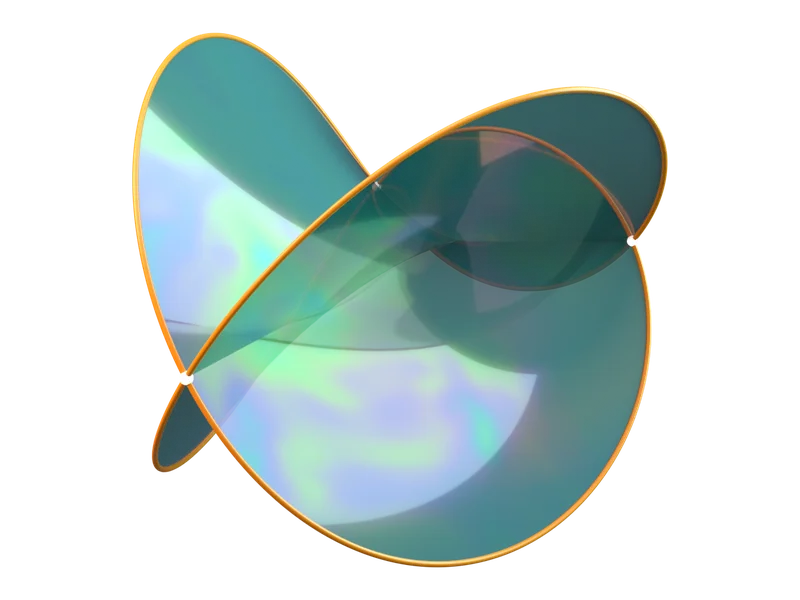
The edge touches itself at 3 points, so it isn't a knot yet.
Each touching point can be pulled apart two ways, which makes eight options. The knot determinant is computed live from the curve: two options give a trefoil, the other six an unknot.
What I added
- Wrote up the linearisation of the minimal surface equation by the Legendre transformation, in both directions. notes (PDF) ↗
- Checked all the surfaces and brackets in the paper symbolically.
- Noticed the recursion is just $\partial_\theta$ in polar coordinates, which is why the chains never end.
- Computed $\Sigma_{14}$ and $\Sigma_{15}$.
- Worked out the knot picture for $\Sigma_6$: the three touching points, the eight ways to resolve them, and the knot determinant of each.
Reading
- A. V. Kiselev, Minimal surfaces associated with nonpolynomial contact symmetries, Fundam. Appl. Math. 12 (2006), 75 - 82. arXiv:math/0603424 ↗
- A. V. Kiselev and G. Manno, On the symmetry structure of the minimal surface equation, Differential Geometry and its Applications, Prague (2005). arXiv:math/0410557 ↗
- J. C. C. Nitsche, Vorlesungen über Minimalflächen, Springer (1974).